

Key points
Rosemary essential oil (Rosmarinus officinalis) comes in three chemotypes: camphor, for the muscles; cineole, for the respiratory tract; verbenone, for the liver. It is not recommended during pregnancy and breastfeeding, for people with epilepsy or high blood pressure, or for children, especially infants. Camphor rosemary must never be taken by mouth.
Overview
Rosemary has the unique characteristic of producing 3 different essential oils, with 3 distinct chemotypes, depending on the region where it grows. It is a major essential oil for the liver, as well as a muscle relaxant.
Benefits
Camphor rosemary essential oil is used externally: it is a muscle relaxant that relieves cramps and aches, and an anti-inflammatory active against osteoarthritis and rheumatism. It also triggers menstruation in case of delayed or absent periods. It stimulates the liver and promotes fat elimination. It also prevents the formation of gallstones and kidney stones. Finally, it is a go-to oil for tinnitus.
Cineole rosemary essential oil is expectorant, anti-infectious for the respiratory tract, antifungal, and digestive. It is indicated for cystitis, candidiasis, sinusitis, ear infections, and colds. A psychic tonic, it stimulates cognitive functions.
Verbenone rosemary essential oil stimulates and decongests the liver. It also acts as a nervous balancer, cardiac and hormonal regulator, respiratory decongestant, and skin regenerator. Anti-infectious, it is recommended for viral gastroenteritis and vaginal infections.
Properties
- Anti-infectious
- Respiratory anti-infectious
- Anti-inflammatory
- Anti-fatigue
- Air purifying
- Digestive
- Hepatic decongestant
- Respiratory decongestant
- Muscle relaxant
- Emmenagogue
- Expectorant
- Antifungal
- Hepatic
- Lipolytic
- Cardiac regulator
- Hormonal regulator
- Skin regenerating
- Nervous balancing
- Intellectual stimulant
- Hepatostimulant
- Neurotonic
How to use rosemary essential oil
By mouth, internal use
Internal use
Full text
Only for cineole rosemary - or possibly verbenone -, take 1 to 2 drops 3 times a day in a teaspoon of honey, olive oil, or almond butter, or on a piece of breadcrumb or an acerola tablet, for 7 days.
On the skin, external use
Massage
- Diluted to 20%
Full text
Dilute to 20% in a massage oil for local application on painful areas.
Through the air
Inhalation
Full text
Use it in inhalation as an air antiseptic and respiratory tract decongestant.
Possible combinations
For a muscle-relaxing massage, camphor rosemary can be combined with EOs of juniper (Juniperus communis), katrafay (Cedrelopsis grevei), wintergreen (Gaultheria procumbens), lemon eucalyptus (Eucalyptus citriodora)...
Rosemary essential oil contraindications
Camphor rosemary EO is forbidden for internal use. Furthermore, all 3 rosemary EO chemotypes are not recommended for children (especially infants), epileptics, during pregnancy and breastfeeding, as well as for people suffering from hypertension. Cineole and verbenone rosemary EOs may optionally be taken internally for digestive issues.
Other use
To stimulate the liver, locally apply 1 drop of verbenone rosemary EO in a teaspoon of olive oil twice a day on the liver area.
Related concerns
The plant and its history
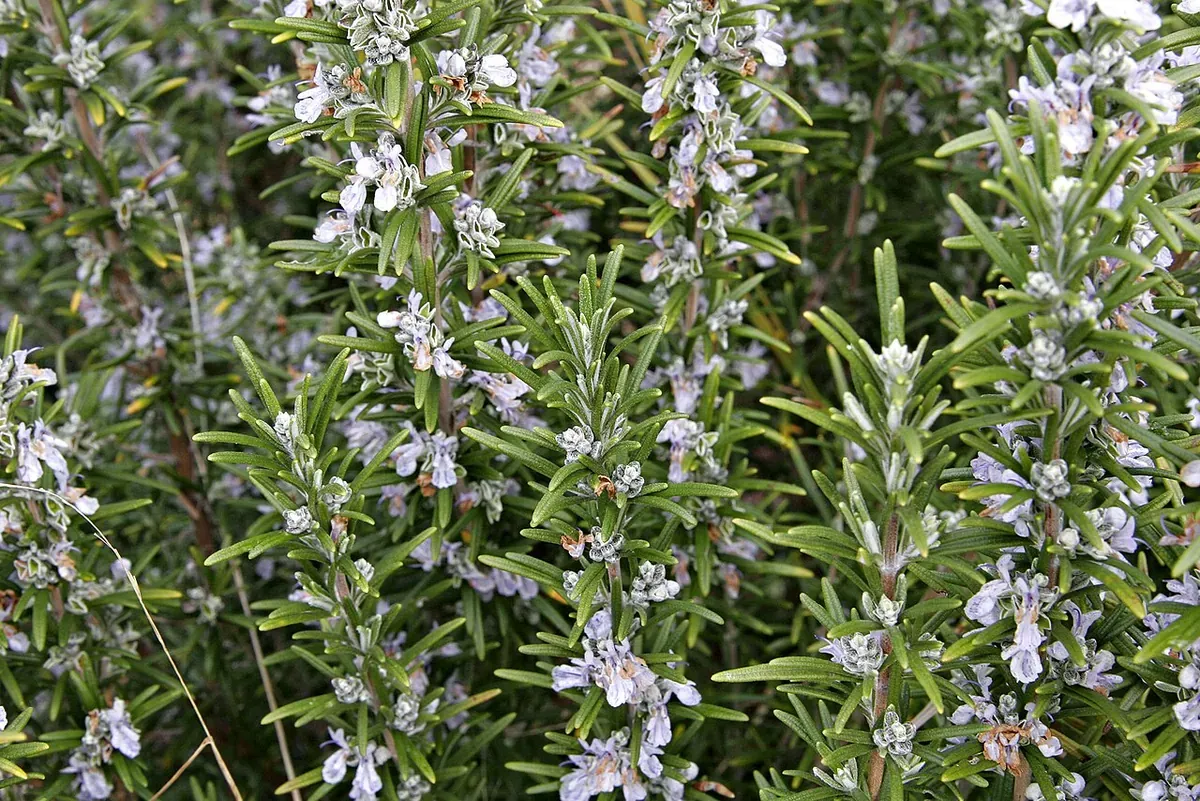
Rosemary is a 50 cm high shrub, typical of the Mediterranean scrubland, with evergreen, narrow leaves that are green on top and silvery-grey underneath, and blue or white flowers. It is an aromatic herb long used as a condiment in cooking, as well as an herbal tea for the liver. It is also a melliferous plant that yields very good honey. It was known to the Egyptians, Greeks, and Romans, and its branches were often associated with religious cults or used in fumigation.
Profile
| Distilled parts | Flowering tops |
|---|---|
| Producing countries | France, Corsica, Morocco |
| Color | Colorless or light yellow |
| Smell | Fresh, camphoraceous or cineolic (eucalyptol) |
| Price range | € to €€ (verbenone) |
| Active ingredients | Camphor rosemary EO (France and Spain): ketone 20%, 1,8-cineole (oxide 20%) Cineole rosemary EO (Morocco): 1,8-cineole (oxide, 40%) Verbenone rosemary EO (France and Corsica): ketone 6%, bornyl acetate (ester 10%) Other components are monoterpenes (a-pinene 10-30%, camphene 5-10%, B-pinene 2-8%), sesquiterpenes (B-caryophyllene 2-4%), monoterpenols (borneol 3%, a-terpineol 1-2%), esters (bornyl acetate)... |
Frequently asked questions
Camphor, cineole or verbenone rosemary: which one should you choose?
It depends on the use. Camphor rosemary (France, Spain) is used on the skin: it relaxes the muscles, relieves cramps and aches, and acts against osteoarthritis and rheumatism. Cineole rosemary (Morocco) is expectorant and anti-infectious for the respiratory tract. Verbenone rosemary (France, Corsica), slightly more expensive, stimulates and decongests the liver and regenerates the skin.
Is rosemary essential oil good for hair?
Its own page does not mention hair. It is the ylang-ylang essential oil page that uses it, to tone the scalp and promote hair regrowth: 1 ml of ylang-ylang and 1 ml of verbenone rosemary, topped up with castor oil to fill a 60 ml bottle. Apply once a day on wet hair. Ylang-ylang is also not recommended during pregnancy and breastfeeding.
Is rosemary essential oil safe for everyone?
No. All three chemotypes are not recommended during pregnancy and breastfeeding, for people with epilepsy or high blood pressure, and for children, especially infants. Camphor rosemary is forbidden by mouth.
Can you take rosemary oil by mouth?
Only cineole rosemary, or possibly verbenone rosemary, for digestive issues: 1 to 2 drops 3 times a day in a teaspoon of honey, olive oil or almond butter, or on a breadcrumb or an acerola tablet, for 7 days. Camphor rosemary is never taken by mouth.
How do you apply rosemary oil to the skin?
Diluted to 20% in a massage oil, as a local application on painful areas. To stimulate the liver, its page suggests 1 drop of verbenone rosemary in a teaspoon of olive oil, twice a day, on the liver area. Inhaled, it acts as an air antiseptic and decongests the respiratory tract.
Which oils go with rosemary for sore muscles?
For a muscle-relaxing massage, its page combines camphor rosemary with juniper, katrafay, wintergreen essential oil and lemon eucalyptus. Against rheumatism and arthritis pain, the clove page also claims a use, always diluted, as clove oil can burn the skin.