

Key points
Peppermint essential oil (Mentha x piperita) is anti-inflammatory, antibacterial and antiviral, and it stimulates digestion. It is strictly prohibited for people with epilepsy or a history of convulsions, and contraindicated for children under 7 and for pregnant and breastfeeding women. Never apply it to a large area because of the icy effect.
Overview
The essential oil distilled from peppermint leaves offers numerous properties: it is anti-inflammatory, antibacterial, and antiviral. Furthermore, it stimulates digestion.
Benefits
Peppermint essential oil is tonifying: it acts on the cardiovascular (it is hypertensive), nervous (it is stimulating), and digestive systems (against nausea, indigestion, liver fatigue, bad breath, or bloating). On a mental level, it promotes concentration.
It stimulates the liver (by activating bile production and helping it drain into the intestine) and the pancreas. Furthermore, it is antibacterial and antiviral, and is indicated for viral hepatitis or gastroenteritis. Antispasmodic, it also soothes colitis.
It is also recognized for skin conditions, of viral or other origins (shingles, chickenpox, eczema, wounds, or hives). It is a remarkable analgesic and anti-inflammatory, recommended for bumps, migraines, ophthalmic shingles, neuritis, pruritus, arthritis, tendinitis, prostatitis, sciatica, and rheumatism...
Finally, it is a decongestant for the respiratory tract, and is recommended for colds, rhinitis, and sinusitis.
Properties
- Analgesic
- Anti-inflammatory
- Antibacterial
- Antispasmodic
- Antiviral
- Cholagogue
- Digestive
- Respiratory decongestant
- Hypertensive
- Neurotonic
- Hepatostimulant
- Pancreatic stimulant
- General tonic
How to use peppermint essential oil
By mouth, internal use
Internal use
Full text
Take 2 drops 3 times a day in a teaspoon of honey, olive oil, or almond butter, or on a piece of breadcrumb or an acerola tablet, for a maximum of 7 days (do not use for prolonged periods).
On the skin, external use
On the skin
- Diluted to 20%
Full text
Dilute to 10 or 20% in a carrier oil for widespread application. It can also be applied neat, but on small areas.
Possible combinations
For digestion, with the EOs of sweet basil (Ocimum basilicum), angelica seed (Angelica archangelica), tarragon (Artemisia dracunculus), and ginger (Zingiber officinale)...
Peppermint essential oil contraindications
Medical consultation recommended
Strictly prohibited for people with epilepsy or a history of convulsions (presence of neurotoxic menthone). Contraindicated for children under 7 (risk of laryngeal spasm linked to menthol) and for pregnant and breastfeeding women. Never apply to a large area because of the icy effect. Do not use for prolonged periods in people with high blood pressure.
Other use
It can simply be taken as a trace on the tongue by wiping a finger on the rim of the bottle, for bad breath or after a heavy meal.
Related concerns
The plant and its history
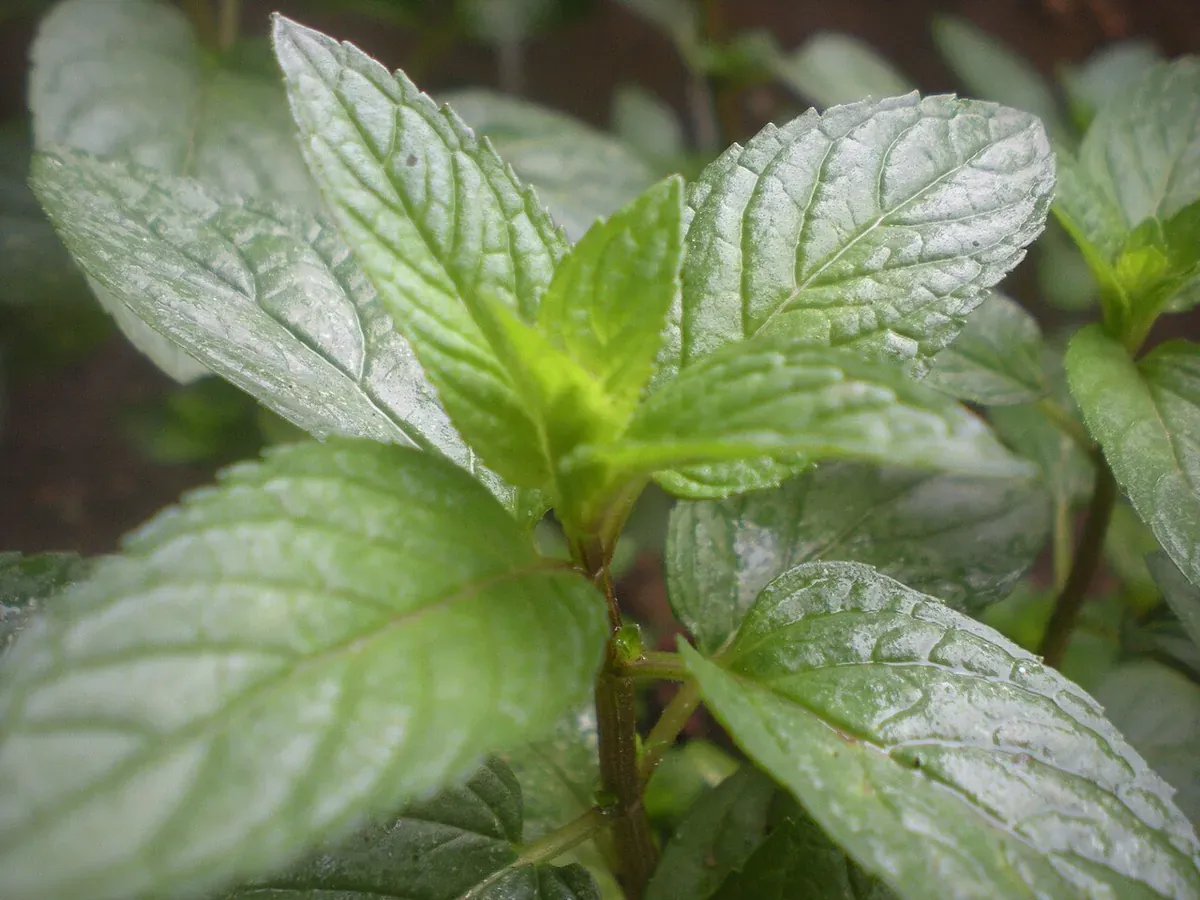
Peppermint is a natural hybrid of watermint (Mentha aquatica) and spearmint (M. spicata). It is a perennial plant measuring less than 1 m in height, with green, serrated, and opposite leaves. It bears small purple flowers clustered in spikes. Known since antiquity for its digestive properties, it was only cultivated in Europe starting in the 17th century. There are numerous species of mint with essential oils, such as cornmint (M. arvensis), bergamot mint (M. citrata), pennyroyal (M. pulegium) - very high in ketones, thus neurotoxic and abortive - and horse mint (M. longifolia).
Profile
| Distilled parts | Leaves |
|---|---|
| Producing countries | Throughout Europe, North America, Morocco, Egypt, India, China... |
| Color | Pale green |
| Smell | Peppery, anise-like, minty |
| Price range | € |
| Active ingredients | Monoterpenols (menthol 50%), monoterpenones (menthone 20%, pulegone, piperitone), oxides (1,8-cineole 5%), esters (menthyl acetate 5%), monoterpenes (alpha- and beta-pinene) |
Frequently asked questions
Who should not use peppermint essential oil?
It is strictly prohibited for people with epilepsy or a history of convulsions (neurotoxic menthone). It is contraindicated for children under 7 (risk of laryngeal spasm linked to menthol) and for pregnant and breastfeeding women. Never apply it to a large area because of the icy effect, and do not use it for prolonged periods if you have high blood pressure. Its page carries the "Medical Advice" mention.
How do you use peppermint oil on the skin?
Dilute it to 10 or 20% in a carrier oil for widespread application. It can also be applied neat, but only on small areas, never on a large area.
Can you take peppermint oil by mouth?
The sources give 2 drops 3 times a day in a teaspoon of honey, olive oil or almond butter (or on a breadcrumb or an acerola tablet), for a maximum of 7 days: do not use it for prolonged periods. It can also be taken as a trace on the tongue, by wiping a finger on the rim of the bottle, for bad breath or after a heavy meal.
What does peppermint oil do for digestion?
It stimulates digestion and acts on nausea, indigestion, liver fatigue, bad breath and bloating. It also stimulates the liver, by activating bile production, and the pancreas. For digestion, the sources pair it with sweet basil, angelica seed, tarragon and ginger.
Peppermint, tea tree or lavender for colds and sinusitis?
Peppermint is a decongestant for the respiratory tract and is recommended for colds, rhinitis and sinusitis, but it is excluded for children under 7 and during pregnancy and breastfeeding. Tea tree oil is indicated for ENT problems, sinusitis included, and lavender is described as useful against ear infections and sinusitis. Each has its own precautions: read them before choosing.
Can peppermint oil be used during pregnancy?
No: it is contraindicated during pregnancy and breastfeeding. Fine lavender and tea tree oil are to be avoided, or not recommended, during the first 3 months of pregnancy.