

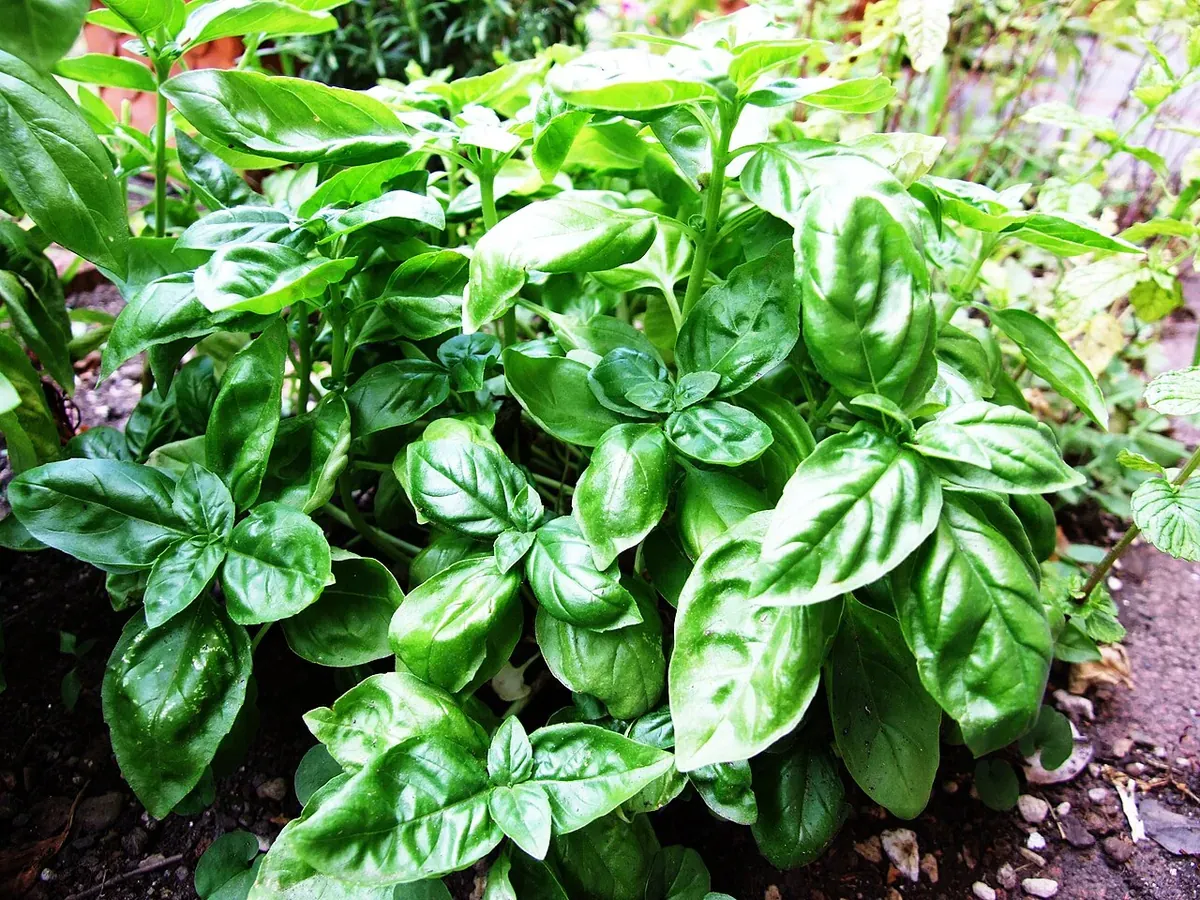
Key points
Basil essential oil, also called tropical or exotic basil (Ocimum basilicum), is above all a digestive oil: it reduces gas and bloating, soothes nausea and calms spasms. It is also used for joint pain and stress. It can be slightly irritating neat on the skin, and it is not recommended during the first 3 months of pregnancy.
Overview
Revered in India where it originates, basil holds a special place in European cuisine for its aromatic and culinary qualities. Digestive par excellence and soothing, it yields a top-tier essential oil endowed with powerful antispasmodic virtues.
Benefits
Tropical basil essential oil is a go-to oil for the intestine and digestive issues in general. It is vermifuge, antispasmodic, and has a reducing effect on gas and bloating (carminative action). It soothes nausea and regulates the autonomic nervous system (which modulates vital functions). It is a very good digestive and hepatic tonic.
It is also a remarkable anti-inflammatory and analgesic for joints: it relieves rheumatism, tendinitis, arthritis, and localized pain, including that of rheumatoid arthritis.
Anti-infectious, it is antibacterial and antifungal. But it is also a powerful antiviral: it can act on spasmodic colitis, diarrhea, gastroenteritis, and it can also be recommended against viral hepatitis.
On an emotional and psychic level, it soothes anxiety, spasmophilia, and allergic disorders (such as hay fever). It fights asthenia and fatigue (overwork), and it also has sedative and calming properties in cases of anxiety, insomnia, emotional shock, or even depression.
It has an action on congestion, such as that of the female pelvis (premenstrual disorders, dysmenorrhea) or the male prostate (especially the 'lettuce-leaf' variety).
Properties
- Analgesic
- Anti-infectious
- Anti-inflammatory
- Antibacterial
- Antifungal
- Antispasmodic
- Antiviral
- Calming
- Carminative
- Digestive
- Sedative
- Digestive tonic
- Hepatostimulant
- Vermifuge
How to use basil essential oil
By mouth, internal use
Internal use
Full text
After meals, take 1 to 2 drops in a teaspoon of olive oil, almond butter, sesame oil, or honey, or 1 drop on a neutral support (tablet, breadcrumb...) 3 times a day for 7 days.
On the skin, external use
On the skin
- Diluted to 20%
Full text
Apply locally to the solar plexus, lower abdomen, or abdomen, optionally diluted to 20% in a vegetable oil.
Possible combinations
To promote digestion, mix basil with the EOs of tarragon (Artemisia dracunculus), peppermint (Mentha x piperita), sweet marjoram (Origanum majorana), cumin (Cuminum cyminum), and angelica seed (Angelica archangelica).
Basil essential oil contraindications
It can be slightly irritating when used pure on the skin. Not recommended during the first 3 months of pregnancy.
Other use
In case of hiccups or an allergy attack, take 1 pure drop on the tongue once a day. In case of bloating or a knot in the stomach, apply 1 pure drop to the solar plexus.
Related concerns
The plant and its history
Recognizable by its large, glossy green oval leaves, basil can only be grown in Europe during the summer. It is an annual plant, 50 cm tall, bearing white, pink, or purple flowers. The name of the plant comes from the Greek basilikon (royal), and its refined fragrance has been associated since antiquity with divine power and protection, for example against magic in Africa. There are many varieties of basil: in aromatherapy, the most common are 3 subspecies of common basil—lettuce-leaf, large green, and bush basil—with different chemotypes depending on geographic origin. Holy basil, or tulsi (Ocimum sanctum), which also originates from India, is a different species.
Profile
| Distilled parts | Flowering tops |
|---|---|
| Producing countries | India, Indian Ocean, Vietnam |
| Color | Pale yellow |
| Smell | Spicy, anise-like, aromatic |
| Price range | € |
| Active ingredients | Phenol methyl ethers (methyl chavicol up to 75%), monoterpenols (linalool 20%, up to 50% depending on the variety) |
Frequently asked questions
Tropical, exotic or Indian basil: is it the same oil?
Yes. These are three names for the same basil, Ocimum basilicum ssp. basilicum, distilled in India, the Indian Ocean and Vietnam. Several kinds are used (lettuce-leaf, large green and bush basil), and their composition changes with the place of origin. Holy basil, or tulsi (Ocimum sanctum), is a different species.
Is basil essential oil safe?
Its page notes only two precautions: neat, it can be slightly irritating to the skin, and it is not recommended during the first 3 months of pregnancy. On the skin, it can be diluted to 20% in a vegetable oil. If in doubt, ask a doctor or pharmacist.
Can you take basil oil by mouth?
Yes, according to its page. After meals, take 1 to 2 drops in a teaspoon of olive oil, almond butter, sesame oil or honey, or 1 drop on a neutral support (tablet, breadcrumb), 3 times a day for 7 days. For hiccups or an allergy attack, take 1 neat drop on the tongue, once a day.
What does basil essential oil do for digestion?
It is its main use. Its page describes it as antispasmodic and carminative: it reduces gas and bloating, soothes nausea and acts as a digestive and liver tonic. For bloating or a knot in the stomach, apply 1 neat drop to the solar plexus. For digestion, it blends with tarragon, cumin, angelica seed, sweet marjoram and peppermint essential oil.
Is basil oil calming?
Yes. Its page describes it as sedative and calming in cases of anxiety, insomnia or emotional shock, and it soothes spasmophilia. The Seville orange page lists it among the soothing oils to blend with, and the Roman chamomile page pairs it with other oils against stress and anxiety.
Does basil oil help with joint pain?
Its page describes it as an anti-inflammatory and analgesic for the joints: rheumatism, tendinitis, arthritis and localized pain. It gives no specific method for this use. Wintergreen essential oil and clove claim similar uses on their own pages, each with its own precautions.