

Key points
Lavender essential oil, also called true lavender or English lavender (Lavandula angustifolia), is the most common and widely used essential oil. Known above all for its soothing properties, it is used for stress, anxiety and insomnia, and for skin problems. It has no known contraindications, but it is to be avoided during the first 3 months of pregnancy.
Overview
Fine lavender essential oil is very common and widely used, as it is the one with which aromatherapy was born. Known above all for its soothing properties, it is also a go-to oil for the skin.
Benefits
Fine lavender essential oil is a reference oil for soothing stress situations, anguish, or anxiety, and all vital disorders of nervous origin: high blood pressure, palpitations, insomnia, or asthma.
It is soothing and relaxing on both emotional and muscular levels. It is a powerful antispasmodic and an effective anti-inflammatory, which is successfully used against cramps, rheumatism, or muscle contractures. On a psychological level, it is sedative and calming, even antidepressant.
Endowed with remarkable healing properties, it is effective against skin problems: eczema, fungal infections, acne, rosacea, burns, psoriasis, dermatitis, cuts, itching...
Its anti-infectious, and notably antibacterial, properties make it very useful against ear infections and sinusitis for example. It is also an insect repellent, keeping lice, fleas, and moths away. It is generally the essential oil used as a first resort for children in case of lice infestation.
Properties
- Anti-infectious
- Anti-inflammatory
- Antibacterial
- Antidepressant
- Antispasmodic
- Anxiolytic
- Calming
- Healing
- Muscle relaxing
- Insecticide
- Insect repellent
- Sedative
How to use lavender essential oil
By mouth, internal use
Internal use
Full text
Take 1 to 2 drops 3 times a day in a teaspoon of honey, olive oil, or almond butter, or on a breadcrumb or an acerola tablet, for 7 days.
On the skin, external use
Massage
- Diluted to 20%
Full text
Diluted to 20% in a massage oil, it can be applied as an anointing on the body, especially on the chest and back. It can also be applied neat on the solar plexus, the inside of the wrists, or the soles of the feet to soothe, or on any skin problem.
Possible combinations
With soothing EOs such as petitgrain bigarade (Citrus aurantium, leaves), neroli (Citrus aurantium, flowers), Roman chamomile (Anthemis nobilis), sweet basil (Ocimum basilicum), sweet marjoram (Origanum majorana), and rose geranium (Pelargonium x asperum), neat or diluted and mixed in a vegetable oil.
Lavender essential oil contraindications
No known contraindications, but to be avoided during the first 3 months of pregnancy.
Other use
To soothe young children, consider lavender hydrosol (floral water), which is gentler, sprayed on the chest. It is also very effective when diffused. This same floral water can be used to keep lice away. For children over 3 years old, 1 drop of essential oil can be applied behind each ear.
Related concerns
The plant and its history
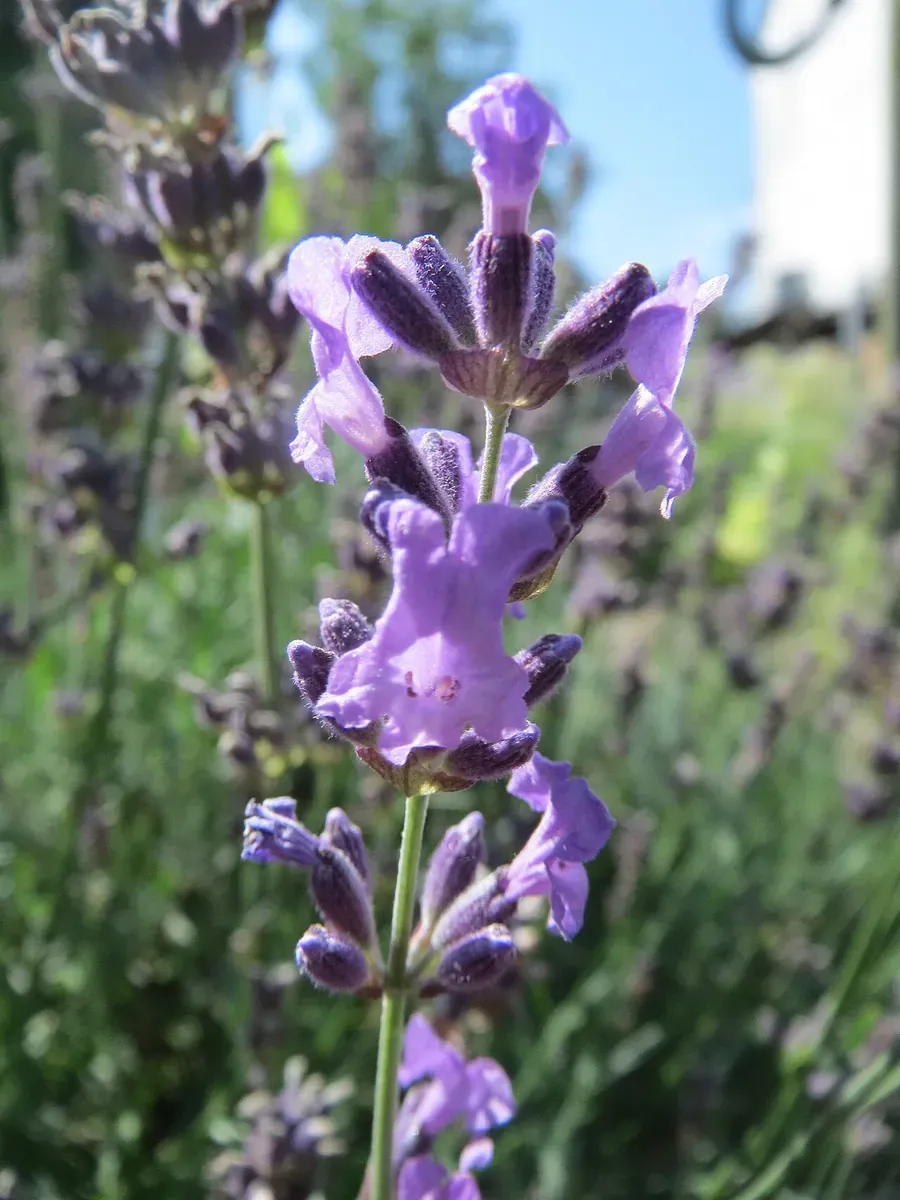
Before its cultivation developed in Provence, fine lavender grew wild at altitudes between 800 and 1,800 m. It differs from spike lavender by its narrow, linear, relatively short leaves (5-6 cm) and by its pale mauve or violet flowers, which are slightly scented and form loose spikes at the top of unbranched stems. Hildegard von Bingen, in the 12th century, already praised its virtues against liver and lung pain, to ward off diseases and lice, and to obtain 'pure knowledge and a pure mind'. René-Maurice Gattefossé accidentally discovered the healing properties of lavender essential oil in the 1910s. This is how modern aromatherapy was born.
Profile
| Distilled parts | Flowering tops |
|---|---|
| Producing countries | Native to the south of France, fine lavender grows up to 1,800 m in altitude |
| Color | Pale yellow or clear |
| Smell | Sweet, floral |
| Price range | €€ |
| Active ingredients | Esters (linalyl acetate 35 to 50%, lavandulyl acetate), monoterpenols (linalool 30 to 40%, terpinen-4-ol), monoterpenes (trans- and cis-beta-ocimene 4%), sesquiterpenes 5-10% (beta-caryophyllene) |
Frequently asked questions
Fine lavender, true lavender, English lavender: what's the difference?
None: these are names for the same plant, Lavandula angustifolia (or L. vera), also called common lavender or narrow-leaved lavender. It is told apart from spike lavender by its narrow, linear, short leaves (5-6 cm) and its pale mauve or purple flowers grouped in loose spikes.
Is lavender essential oil safe?
It has no known contraindications, but it is to be avoided during the first 3 months of pregnancy. To soothe young children, the sources suggest lavender hydrosol (floral water), which is gentler.
How do you use lavender essential oil?
On the skin, diluted to 20% in a massage oil, it can be applied as an anointing on the body, especially on the chest and back. It can also be applied neat on the solar plexus, the inside of the wrists or the soles of the feet to soothe, or on a skin problem. By mouth, the sources give 1 to 2 drops 3 times a day in a teaspoon of honey, olive oil or almond butter (or on a breadcrumb or an acerola tablet), for 7 days.
Does lavender help you sleep?
The sources describe lavender as sedative and calming, and list insomnia among the disorders of nervous origin it is used for, along with stress, anguish, anxiety and palpitations. To soothe, it can be applied neat on the solar plexus, the inside of the wrists or the soles of the feet.
Can children use lavender essential oil?
To soothe young children, lavender hydrosol is sprayed on the chest. For children over 3 years old, 1 drop of essential oil can be applied behind each ear. Lavender is generally the essential oil used first for children in case of lice.
Which essential oils blend well with lavender?
The sources pair it with other soothing oils: petitgrain bigarade (Seville orange), neroli, sweet chamomile, basil essential oil, knotted marjoram and scented geranium, neat or diluted in a vegetable oil.