

Key points
Rose geranium essential oil (Pelargonium x asperum), also called Bourbon geranium, is the geranium oil distilled from the leaves. It is used for the skin (fungal infections, acne, wrinkles), circulation and stress, and it keeps mosquitoes away. It has no known contraindications, but it is not recommended during the first 3 months of pregnancy.
Overview
Rose geranium produces a highly versatile essential oil, combining a circulatory action, a protective dermatological action for the skin - making it an effective antifungal - and an insect-repelling action to keep lice and mosquitoes away.
Benefits
Rose geranium essential oil is an effective circulatory tonic in preventing varicose veins, or even phlebitis (but not for confirmed phlebitis!). Hemostatic and astringent, it can also stop bleeding.
It has an anti-inflammatory action and can be applied to tendon and muscle pain, in case of rheumatism or arthritis. It also offers decongestant properties for hemorrhoids, lymphedema, or prostate enlargement.
Its remarkable antifungal and regenerating properties are used for many skin problems: wrinkles, fungal infections, eczema, stretch marks, acne, burns, or cuts. It is also recommended internally for gynecological yeast infections.
It regulates the nervous system through its soothing effects against stress and nervousness, or in case of nervous exhaustion.
Finally, it is also known as an insect repellent, as it effectively keeps fleas, lice, and mosquitoes away.
Properties
- Anti-inflammatory
- Antifungal
- Antispasmodic
- Calming
- Astringent
- Circulatory stimulant
- Decongestant
- Hemostatic
- Insect repellent
- Skin protective
- Nervous system balancer
- Regenerating
How to use rose geranium essential oil
By mouth, internal use
Internal use
Full text
Take 1 to 2 drops 3 times a day in a teaspoon of honey, olive oil, or almond butter, or on an acerola tablet, for 7 days.
On the skin, external use
External use
Full text
Dilute in a carrier oil (maximum 5% for the face, 20% for the body) for local application or massage. It is possible to place 1 drop on clothing, a pillowcase... to keep insects away.
Possible combinations
For skin beauty care, with Ho wood (Cinnamomum camphora ct linalool), cistus (Cistus ladaniferus), patchouli (Pogostemon cablin), and palmarosa (Cymbopogon martinii) essential oils, in rosehip carrier oil (Rosa rubiginosa).
Rose geranium essential oil contraindications
Medical consultation recommended
No known contraindications, but it is not recommended during the first 3 months of pregnancy. Caution: in case of confirmed phlebitis, do not apply anything and see a doctor immediately.
Other use
Apply 1 pure drop to a small cut to stop bleeding, optionally with 1 drop of Cistus essential oil (Cistus ladaniferus).
Related concerns
The plant and its history
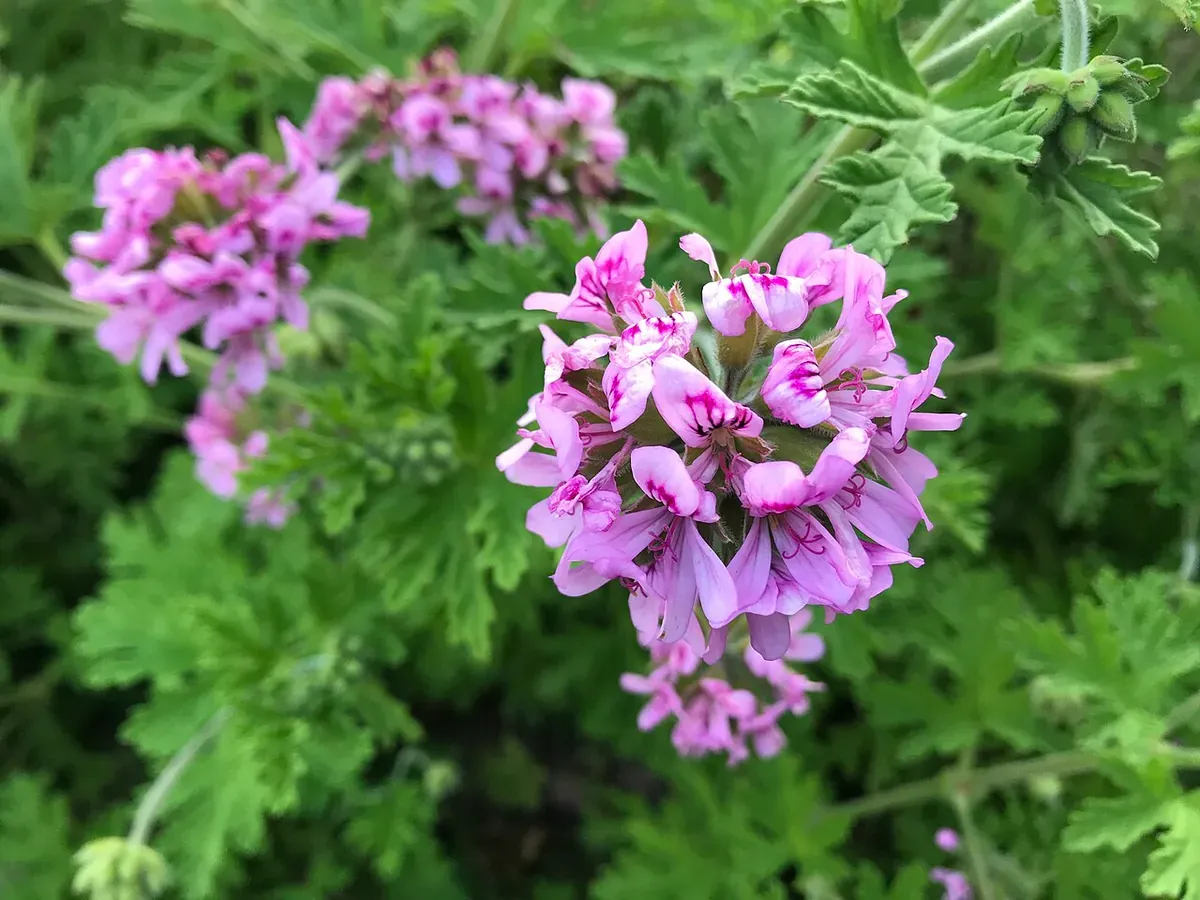
There are nearly 500 species of non-hardy "geraniums" (actually pelargoniums), which develop a wide variety of scents - ranging from lemongrass to mint or chocolate. Rose geranium is native to Africa. While the wild plant can reach 1.20 m in height, there are more than 300 cultivated varieties, some not exceeding 20 to 30 cm. The leaves are indented, and the flowers have 5 pink, red, or white petals. Only a few geranium species are distilled for their essential oil - in particular the 'Bourbon' variety of rose geranium, native to Réunion. However, several other species are used in perfumery and cosmetics.
Profile
| Distilled parts | Leaves |
|---|---|
| Producing countries | Réunion Island and Madagascar for the 'Bourbon' variety. It is also produced in Egypt and China |
| Color | Yellow, light green |
| Smell | Rose, with a hint of lychee |
| Price range | €€ |
| Active ingredients | Monoterpenols (citronellol 25 to 30%, geraniol 10 to 15%), esters (25%: citronellyl and geranyl formate and acetate...), aldehydes (citrals 1%: geranial, neral), monoterpenes, sesquiterpenes (B-caryophyllene), ketones |
Frequently asked questions
Rose geranium or Bourbon geranium: what is the difference?
Bourbon geranium is the 'Bourbon' variety of rose geranium, Pelargonium x asperum, native to Réunion and produced in Réunion and Madagascar. Rose geranium is also produced in Egypt and China. This "geranium" is actually a pelargonium. Its oil smells of rose, with a hint of lychee.
Can you put geranium oil on your face?
Yes, diluted to 5% at most in a vegetable oil. Its page recommends it for many skin problems: wrinkles, fungal infections, eczema, stretch marks, acne. For beauty care, it pairs it with Ho wood, cistus, patchouli and palmarosa, in rosehip carrier oil.
Does geranium oil repel mosquitoes?
Yes, its page describes it as an insect repellent: it keeps fleas, lice and mosquitoes away. Place 1 drop on clothing or a pillowcase. The lemon eucalyptus essential oil page pairs it with rose geranium to keep mosquitoes away, and the litsea page counts it among the insect-repelling oils.
Is geranium essential oil safe?
Its page notes no known contraindications, but it is not recommended during the first 3 months of pregnancy. It can help prevent varicose veins, but not on a confirmed phlebitis: in that case, apply nothing and see a doctor immediately. Its page carries the "Medical Advice" mention.
How do you use rose geranium essential oil?
On the skin, diluted in a vegetable oil, at 5% at most for the face and 20% for the body. On a small cut, 1 neat drop helps stop the bleeding. By mouth: 1 to 2 drops 3 times a day in a teaspoon of honey, olive oil or almond butter, or on an acerola tablet, for 7 days. For hemorrhoids, the Italian helichrysum page gives 3 drops of rose geranium and 3 drops of helichrysum in a teaspoon of St. John's wort oil, applied locally.
Does rose geranium help with stress?
Its page credits it with soothing effects against stress and nervousness, or in case of nervous exhaustion: it regulates the nervous system. The lavender essential oil page pairs it with other soothing oils, neat or diluted in a vegetable oil.