

Key points
Helichrysum oil, from Italian helichrysum or immortelle (Helichrysum italicum), is the reference essential oil for bumps, bruises and hematomas. Anti-inflammatory and circulatory, it is also used for rheumatism. It is contraindicated during pregnancy and breastfeeding, under 3 and with epilepsy, and must be avoided with anticoagulants: ask a doctor.
Overview
Italian Helichrysum essential oil is the reference oil for bumps, bruises, and hematomas. Despite its high price, it is indispensable and deserves a place in any medicine cabinet.
Benefits
It is the go-to essential oil for bumps, bruises, contusions, hematomas, and ecchymosis, as well as rosacea. Indeed, it is anticoagulant, circulatory, healing, and anti-inflammatory. It is also recommended for rheumatism, arthritis, rheumatoid arthritis, or carpal tunnel syndrome. It prevents the risk of phlebitis and has a decongestant action on the venous and lymphatic systems.
It is anti-infectious and antiviral, and has a fluidifying action on bronchopulmonary mucus (it is anti-bronchitic).
Internally, it acts on autoimmune diseases, liver diseases, or cholesterol. It stimulates liver and pancreatic functions.
Emotionally, when inhaled, it can be considered a kind of arnica for "bruised souls" or psychological blocks, especially those originating in childhood.
Properties
- Anti-infectious
- Anti-inflammatory
- Anti-bronchitic
- Anticoagulant
- Antiviral
- Calming
- Healing
- Circulatory stimulant
- Hepato-biliary draining
- Lymphatic decongestant
- Venous decongestant
- Hepatic detoxifying
- Mucolytic
- Hepatostimulant
- Pancreatic stimulant
How to use italian helichrysum essential oil
By mouth, internal use
Internal use
Full text
Take 1 to 2 drops 3 times a day in a teaspoon of honey, olive oil, or almond butter, on bread crumbs or an acerola tablet, for a maximum of 7 days and on the advice of a doctor. Do not use for a prolonged period without supervision.
On the skin, external use
On the skin
Full text
For toothache, while waiting to see a dentist, apply 1 drop diluted in 4 drops of carrier oil locally to the gum.
On the skin
Full text
To calm emotions, simply inhale directly from the bottle 1 to 2 times a day.
External use
Full text
Dilute in a carrier oil (at a maximum of 5% for the face, 20% for the body) for local application or massage.
Recipe
For an anti-hemorrhoid blend, with the following essential oils
- On the skin
Ingredients
- Essential oil3 drops of Rose Geranium EO
- Other ingredient3 drops of Italian Helichrysum EO
Directions
- In a teaspoon of St.
- John's Wort oil, for local application.
Full text
For an anti-hemorrhoid blend, with the following essential oils:
3 drops of Rose Geranium EO
3 drops of Italian Helichrysum EO
In a teaspoon of St. John's Wort oil, for local application.
Possible combinations
For bumps, wounds, and bruises, mix with the EOs of Cistus (Cistus ladaniferus), Wintergreen (Gaultheria procumbens), and Katrafay (Cedrelopsis grevei), in an Arnica carrier oil (Arnica montana).
Italian helichrysum essential oil contraindications
Medical consultation recommended
Contraindicated in pregnant and breastfeeding women, people with epilepsy or sensitive to ketones, and children under 3. Must be avoided by people taking anticoagulants or with clotting disorders. Never apply to existing phlebitis.
The plant and its history
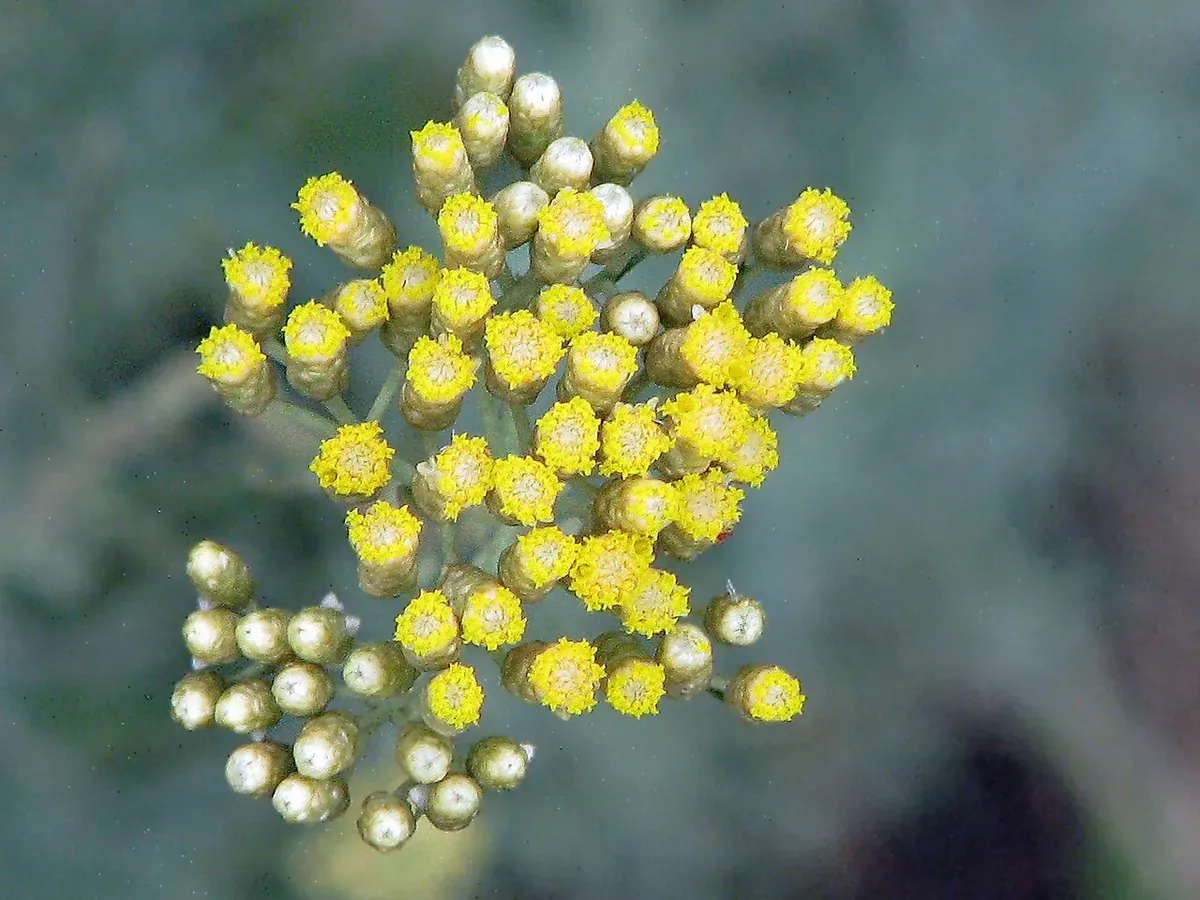
Italian Helichrysum is a perennial herb that grows 40 to 50 cm high, featuring narrow leaves covered in silver-grey down and clusters of orange-yellow flowers grouped in corymbs. It grows on sandy soils in Eastern Europe and around the Mediterranean basin, particularly in Corsica and Sicily. It was traditionally used in herbal medicine to drain the bile ducts and effectively detoxify the liver, but it is rarely used today as an herbal tea. Nowadays, it is primarily known for its essential oil.
Profile
| Distilled parts | Flowering tops |
|---|---|
| Producing countries | Native to the Mediterranean region, it is mainly harvested in Sicily, Corsica, and Croatia |
| Color | Clear to light yellow |
| Smell | Floral, spicy, with a note of turmeric |
| Price range | €€€ |
| Active ingredients | Ketones 10% (b-diones, italidiones I, II, and III), esters (neryl acetate 30 to 40%, neryl isobutyrate, neryl propionate 5%), sesquiterpenes (B-caryophyllene, y-curcumene), monoterpenols (a-terpineol, terpinen-4-ol, nerol), monoterpenes (limonene 5%, a-pinene, y-terpinene, italicene) |
Frequently asked questions
Are helichrysum, immortelle and everlasting the same oil?
Yes. Immortelle, everlasting and Italian everlasting are other names for Italian helichrysum, Helichrysum italicum. It is a perennial herb 40 to 50 cm high, with narrow leaves covered in silver-grey down and orange-yellow flowers. Its essential oil is distilled from the flowering tops, harvested mainly in Sicily, Corsica and Croatia.
How do you use helichrysum oil on a bruise?
Its page recommends diluting it in a carrier oil, at a maximum of 20% on the body and 5% on the face, for local application or massage. For bumps, wounds and bruises, it suggests mixing it with cistus, wintergreen and katrafay in arnica oil. The lemon eucalyptus oil page also gives a massage oil against bruising: 5 ml of lemon eucalyptus, 6 ml of wintergreen and 1 ml of helichrysum, topped up with arnica oil to 60 ml.
Can you use helichrysum oil if you take blood thinners?
No. Its page describes it as anticoagulant and says it must be avoided by people taking anticoagulants or with clotting disorders. Never apply it to existing phlebitis. If in doubt, ask your doctor.
What are the side effects and contraindications of helichrysum oil?
Its page lists several contraindications: pregnancy and breastfeeding, children under 3, people with epilepsy or sensitive to ketones, and anticoagulant treatment. By mouth, it gives 1 to 2 drops 3 times a day in a teaspoon of honey, olive oil or almond butter (or on breadcrumbs or an acerola tablet), for a maximum of 7 days and on the advice of a doctor, never for a prolonged period without supervision.
Can helichrysum oil help with a toothache?
While waiting to see a dentist, its page suggests applying 1 drop diluted in 4 drops of carrier oil locally to the gum. The clove bud page claims the same use, with the same dilution, and adds that an abscess calls for a prompt visit to the dentist.
What else is helichrysum essential oil used for?
For hemorrhoids, its page gives 3 drops of Bourbon geranium and 3 drops of helichrysum in a teaspoon of St. John's wort oil, for local application. Inhaled directly from the bottle 1 to 2 times a day, it helps calm emotions. It sits in the high price range, yet its page considers it worth a place in the medicine cabinet for bumps and bruises.