

Key points
Tea tree essential oil (Melaleuca alternifolia) is described as the champion of anti-infectious essential oils: it is effective against bacteria, viruses and fungi. It can be applied neat to the skin, except in case of sensitive skin. Some allergic people react to it, so test with a single drop in the crook of the arm. It is not recommended during the first 3 months of pregnancy.
Overview
Tea tree essential oil is indispensable in the medicine cabinet, despite its unappealing scent. It is a major anti-infectious essential oil: it is effective against bacteria, viruses, and fungi.
Benefits
Tea tree essential oil is a very versatile essential oil against infections (bacterial or viral), parasitic infections, mycoses, and candidiasis (it is a fungicide). It also stimulates immune defenses. It is also indicated for oral-dental conditions (mouth ulcers, gingivitis, or tooth abscesses) and for treating ENT problems (sinusitis, otitis, tonsillitis, bronchitis, or rhinopharyngitis).
It fights gynecological and urinary tract problems (cystitis, vulvitis, vaginitis, or candidiasis). In the intestinal tract, it fights viral or bacterial gastroenteritis or worm infections. On the skin, it acts on warts, mycoses, eczema, herpes, shingles, chickenpox, and wounds.
Applied to the skin, it is also highly effective: it decongests the venous and lymphatic systems, and is indicated in the prevention of varicose veins, hemorrhoids, or heavy legs. It protects against burns during radiotherapy sessions and is effective against skin parasites (scabies or ringworm, for example).
Tonic, it helps fight fatigue, especially cardiac fatigue. On a psychological level, it is balancing.
Properties
- Anti-infectious
- Antibacterial
- Antifungal
- Antiviral
- Lymphatic decongestant
- Venous decongestant
- Immunostimulant
- Versatile
- Skin protective
- General tonic
- Balancing
How to use tea tree essential oil
By mouth, internal use
Internal use
Full text
Take 2 drops 2 to 3 times a day in a teaspoon of honey, olive oil, or almond butter, or on a piece of breadcrumb or an acerola tablet, for 7 days.
On the skin, external use
Massage
Full text
Dilute to a maximum of 20% in a massage oil. It can also be applied neat to the skin (except in case of sensitive skin), as it is more effective this way. It can be included in shampoos, soaps, intimate hygiene gels...
Possible combinations
With other antiviral essential oils such as mandravasarotra (Cinnamosma fragrans), niaouli (Melaleuca quinquenervia), cajeput (Melaleuca cajuputii), or diluted with phenol-rich essential oils such as compact oregano (Origanum vulgaris var. compact) or Spanish oregano (Corydothymus capitatus), which will act complementarily against resistant germs.
Tea tree essential oil contraindications
Medical consultation recommended
Some allergic individuals experience skin reactions. Test with 1 single drop in the crook of the arm. Not recommended for pregnant women during the first 3 months of pregnancy.
Other use
Whatever the type of infection, the recommended method is to locally apply 3 neat drops to the skin, massaging gently to help absorption. During radiotherapy sessions, it can be applied before or after, ensuring that the skin is completely dry at the time of the sessions.
Related concerns
The plant and its history
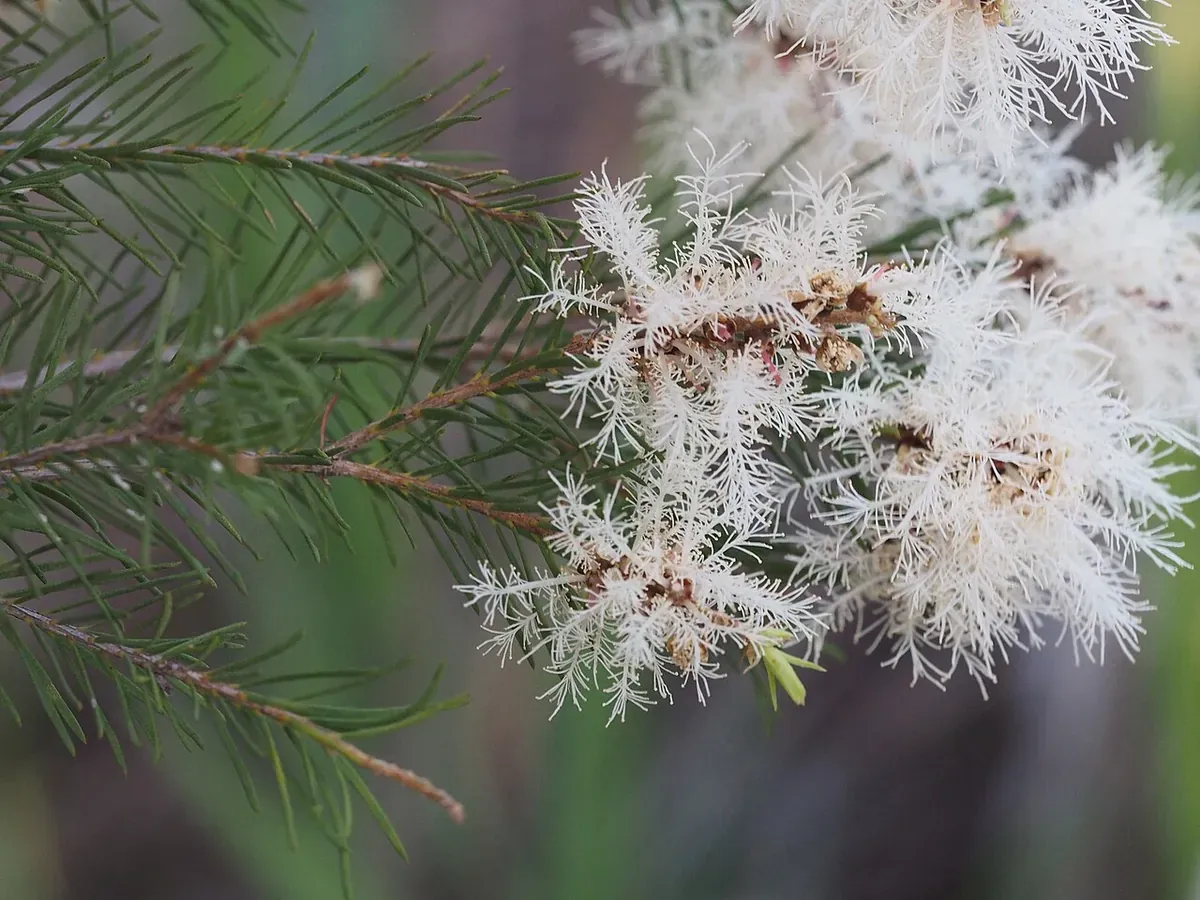
Native to Australia, the tea tree is a small tree related to niaouli and cajeput, which can reach 10 m in the wild. It has evergreen, green, narrow, lanceolate leaves, and highly fragrant white flowers. Due to its impressive antiseptic properties, it is now cultivated on a large scale, particularly in Australia. However, it is sensitive to periods of drought, during which its natural resources are threatened. Nevertheless, it is a plant highly resistant to parasite attacks, which Aborigines have known and used as an infusion for thousands of years. Care should be taken not to confuse it with manuka (Leptospermum scoparium), also called tea tree, which produces a different essential oil.
Profile
| Distilled parts | Leaves |
|---|---|
| Producing countries | Mainly Australia, also produced in South Africa, India, Malaysia |
| Color | Light yellow |
| Smell | Aromatic, terpenic, strong |
| Price range | € |
| Active ingredients | Monoterpenols 40-50% (terpinen-4-ol to 45%, a-terpineol 3%), monoterpenes 40-50% (a-pinene, a-thujene, a-terpinene 10%, y-terpinene 20%, para-cymene 2%), sesquiterpenes 6% (B-caryophyllene, aromadendrene, viridiflorene...), sesquiterpenols 1% (viridiflorol, cubenol, globulol...), oxides (1,8-cineole 5 to 15%) |
Frequently asked questions
What is tea tree oil used for?
The sources present it as one of the most versatile oils against infections, bacterial or viral, as well as parasitic infections, mycoses and candidiasis. It is also indicated for oral-dental conditions (mouth ulcers, gingivitis, tooth abscesses) and ENT problems (sinusitis, otitis, tonsillitis, bronchitis, rhinopharyngitis). On the skin, it acts on warts, eczema, herpes, shingles, chickenpox and wounds. It also stimulates immune defenses.
How do you apply tea tree oil to the skin?
Dilute it to a maximum of 20% in a massage oil. It can also be applied neat, except on sensitive skin, as it is more effective this way. Whatever the type of infection, the sources recommend locally applying 3 neat drops to the skin, massaging gently to help absorption.
Can you take tea tree oil by mouth?
The sources give 2 drops 2 to 3 times a day in a teaspoon of honey, olive oil or almond butter (or on a breadcrumb or an acerola tablet), for 7 days. Its page carries the "Medical Advice" mention: ask a doctor or a pharmacist before using it.
Can tea tree oil cause a skin reaction?
Yes, in some allergic people. Test with a single drop in the crook of the arm first, and do not apply it neat on sensitive skin.
Is tea tree oil safe during pregnancy?
It is not recommended during the first 3 months of pregnancy. By comparison, peppermint is contraindicated during pregnancy and breastfeeding, and lavender is to be avoided during the first 3 months.
Which other oils in the guide are anti-infectious?
Lavender essential oil has anti-infectious, notably antibacterial, properties and is described as useful against ear infections and sinusitis. Peppermint is antibacterial and antiviral. Do not confuse tea tree with manuka (Leptospermum scoparium), sometimes also called tea tree, which gives a different oil.