

Key points
Blue gum eucalyptus oil (Eucalyptus globulus) acts mainly on the nose, throat and bronchi: its page cites it for bronchitis, sinusitis, rhinopharyngitis and flu. Expectorant, it clears the airways. It is to be avoided in case of asthma, during pregnancy and breastfeeding, and in children under 6.
Overview
Well known for its effectiveness on the respiratory tract, blue gum eucalyptus has adapted very well to the Mediterranean climate, where it has thrived since its introduction in the 18th century to drain marshland. Its essential oil is expectorant and anti-infectious.
Benefits
Blue gum eucalyptus essential oil acts mainly on the ENT tract against all winter ailments. It is the go-to oil for laryngitis, tonsillitis, bronchitis, ear infections, sinusitis, or rhinopharyngitis. It is expectorant and decongests the airways (it is mucolytic). However, care must be taken regarding its drying effect on mucous membranes in sensitive individuals (see contraindications opposite).
But its action also results from antiviral properties (against the flu, for example), antibacterial, and antifungal properties: it is active against E. coli responsible for cystitis, Staphylococcus aureus, pneumococcus, and streptococcus, as well as against fungi such as Candida albicans.
Its anti-infectious properties also apply to the skin - against dermatitis (cutaneous inflammation of bacterial or fungal origin). To a lesser extent, it is an intestinal antiparasitic. Finally, it is an insect repellent, although lemon eucalyptus is more effective at keeping insects away.
Properties
- Anti-infectious
- Antibacterial
- Antifungal
- Intestinal antiparasitic
- Respiratory antiseptic
- Antiviral
- Air purifying
- Respiratory decongestant
- Expectorant
- Insect repellent
- Mucolytic
- Respiratory
How to use blue gum eucalyptus essential oil
By mouth, internal use
Internal use
Full text
Swallow 1 to 2 drops 3 times a day in a teaspoon of honey, olive oil, or almond butter, for 7 days.
On the skin, external use
External use
Full text
Or dilute in a vegetable oil (maximum 5% for the face, 20% for the body).
Through the air
Diffusion
Full text
Diffuse to purify the air (using a diffuser or a radiator humidifier).
Recipe
Recipe
Directions
- In case of a cold, pour 3 drops into a teaspoon of sweet almond oil (Prunus dulcis) to apply to the chest, back, throat, or around the ears, according to your needs.
Full text
In case of a cold, pour 3 drops into a teaspoon of sweet almond oil (Prunus dulcis) to apply to the chest, back, throat, or around the ears, according to your needs.
Possible combinations
With other respiratory EOs such as ravintsara (Cinnamomum camphora ct 1,8-cineole), saro (Cinnamosma fragrans), eucalyptus radiata (Eucalyptus radiata)...
Blue gum eucalyptus essential oil contraindications
Asthma (avoid on congested bronchi), pregnancy, breastfeeding, and children under 6 (Eucalyptus radiata is more suitable for children, preferably applied to the back). As it contains traces of ketones, blue gum eucalyptus can sometimes cause drying of the mucous membranes and asthma-like symptoms; it must therefore be used with caution.
The plant and its history
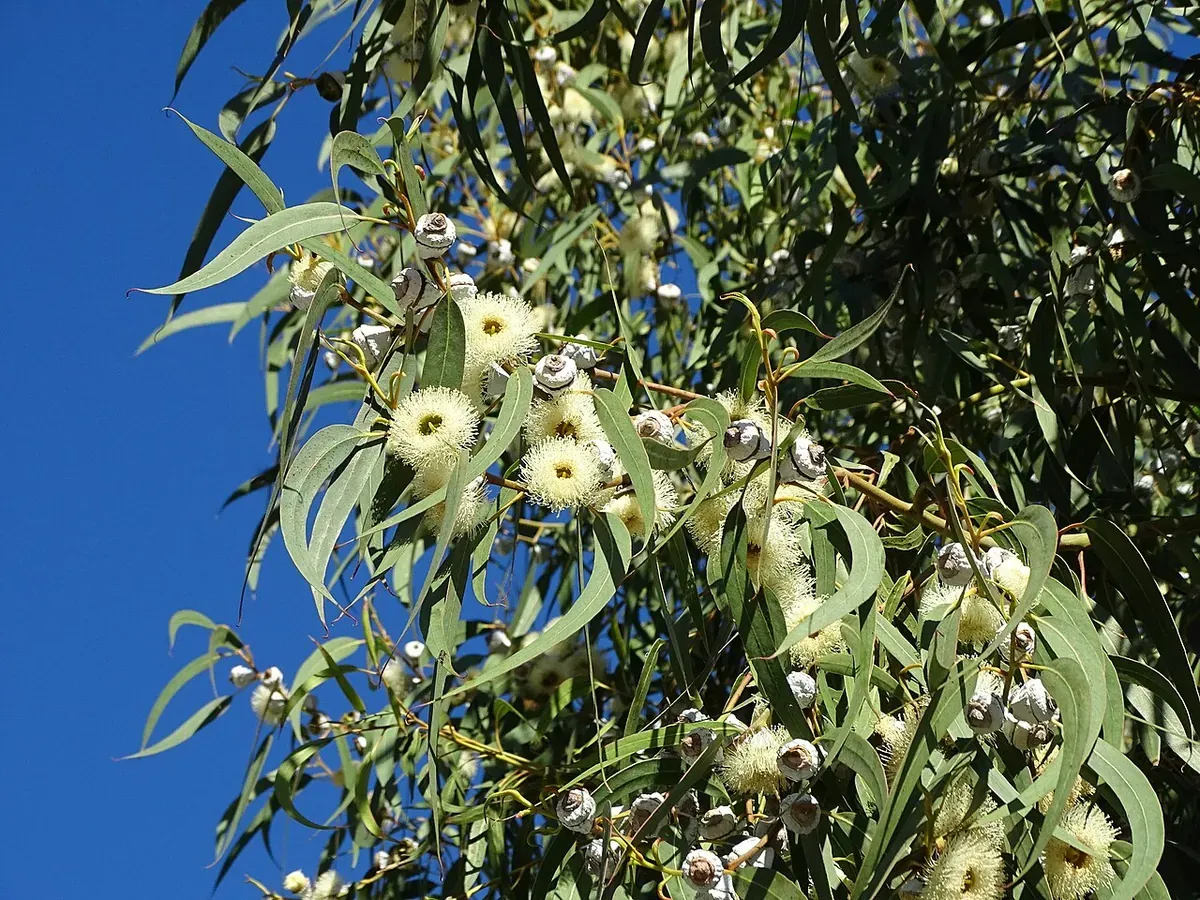
This tall tree (50 m high) is recognizable by its blue-gray bark and its long, lanceolate, blue-gray, aromatic leaves. The solitary flowers produce fruits shaped like small conical boxes. Native to Australia, it was introduced to southern Europe in the 18th century to fight malaria. Indeed, being very water-intensive, it helped drain many marshy areas, thereby reducing the mosquito population. From that time on, eucalyptus wood was destined for the paper industry. However, its development occurred at the expense of native species. The essential oil was already used in the 19th century as a disinfectant, and it is now included in many hygiene products, thanks to its high antiseptic efficacy combined with low cost.
Profile
| Distilled parts | Leaves |
|---|---|
| Producing countries | Native to Australia, it is now produced worldwide, particularly in Spain, Portugal, China, Africa, Madagascar, and South America (Ecuador) |
| Color | Colorless to pale yellow |
| Smell | Fresh, cineolic (eucalyptol) |
| Price range | € |
| Active ingredients | Oxides (1,8-cineole or eucalyptol 70% up to 90%), sesquiterpenes (aromadendrene), monoterpenes (para-cymene 5-10%, alpha-pinene 5-10%, limonene 5-10%), monoterpenols, sesquiterpenols, ketones (traces only) |
Frequently asked questions
What are the benefits of eucalyptus globulus oil?
It acts mainly against winter ailments: laryngitis, tonsillitis, bronchitis, ear infections, sinusitis or rhinopharyngitis. It is expectorant and decongests the airways. It is also antiviral (against the flu, for example), antibacterial and antifungal, and on the skin it acts against dermatitis. It repels insects, but less than lemon eucalyptus.
Eucalyptus globulus, radiata or lemon eucalyptus: what is the difference?
Blue gum mainly serves for winter ailments, from the nose to the bronchi. Its page finds eucalyptus radiata more suitable for children. Lemon eucalyptus is mainly an anti-inflammatory, for muscle and joint pain, and it keeps insects away more effectively than blue gum.
Who should avoid blue gum eucalyptus oil?
Avoid it in case of asthma and on congested bronchi, during pregnancy and breastfeeding, and before age 6; for children, its page suggests eucalyptus radiata instead, preferably applied to the back. It contains traces of ketones: it can sometimes dry the mucous membranes and cause asthma-like symptoms. Use it with caution.
How do you use eucalyptus oil for a cold?
Pour 3 drops into a teaspoon of sweet almond oil and apply to the chest, back, throat or around the ears. On the skin, dilute it to 5% at most for the face and 20% for the body. It blends with other respiratory oils: ravintsara, saro (Cinnamosma fragrans) or eucalyptus radiata.
Can you put blue gum eucalyptus oil in a diffuser?
Yes: its page suggests diffusing it to purify the air, with a diffuser or a radiator humidifier. The precautions still apply: asthma, pregnancy, breastfeeding and children under 6.
Can you take eucalyptus globulus oil by mouth?
Yes: 1 to 2 drops 3 times a day in a teaspoon of honey, olive oil or almond butter, for 7 days.